



Skip to content
Ocean Side Appraisals

Commercial property insurance appraisal

Independent appraisers for buildings, contents and business income.

When you and your insurer disagree on the value of a commercial loss, the appraisal clause in your policy settles it without a lawsuit. We serve as your appraiser, from reading the policy to the signed award.

A flat fee, never a percentage of the award. We take commercial claims in every state but Minnesota.

An isometric drawing of a two-storey retail and office building. The damaged roof and three storefronts are clouded as the scope of loss. 60′-0″ 1 2 3 4 5 6

What the claim is made of, keyed to the drawing

  1. Roof assembly Deck to membrane, priced as one system
  2. Building systems Rooftop units, electrical, fire protection
  3. Storefronts and finishes Glazing, canopies, tenant improvements
  4. Contents and stock Business personal property
  5. Business income The weeks the business cannot trade
  6. Value of the building The figure coinsurance is measured against

What a commercial property claim covers

A commercial property policy is built from separate coverages, each with its own limit, its own way of valuing what was lost, and often its own deductible. When a building is damaged, most of them are triggered at once. The appraisal has to value each one, and keep them apart.

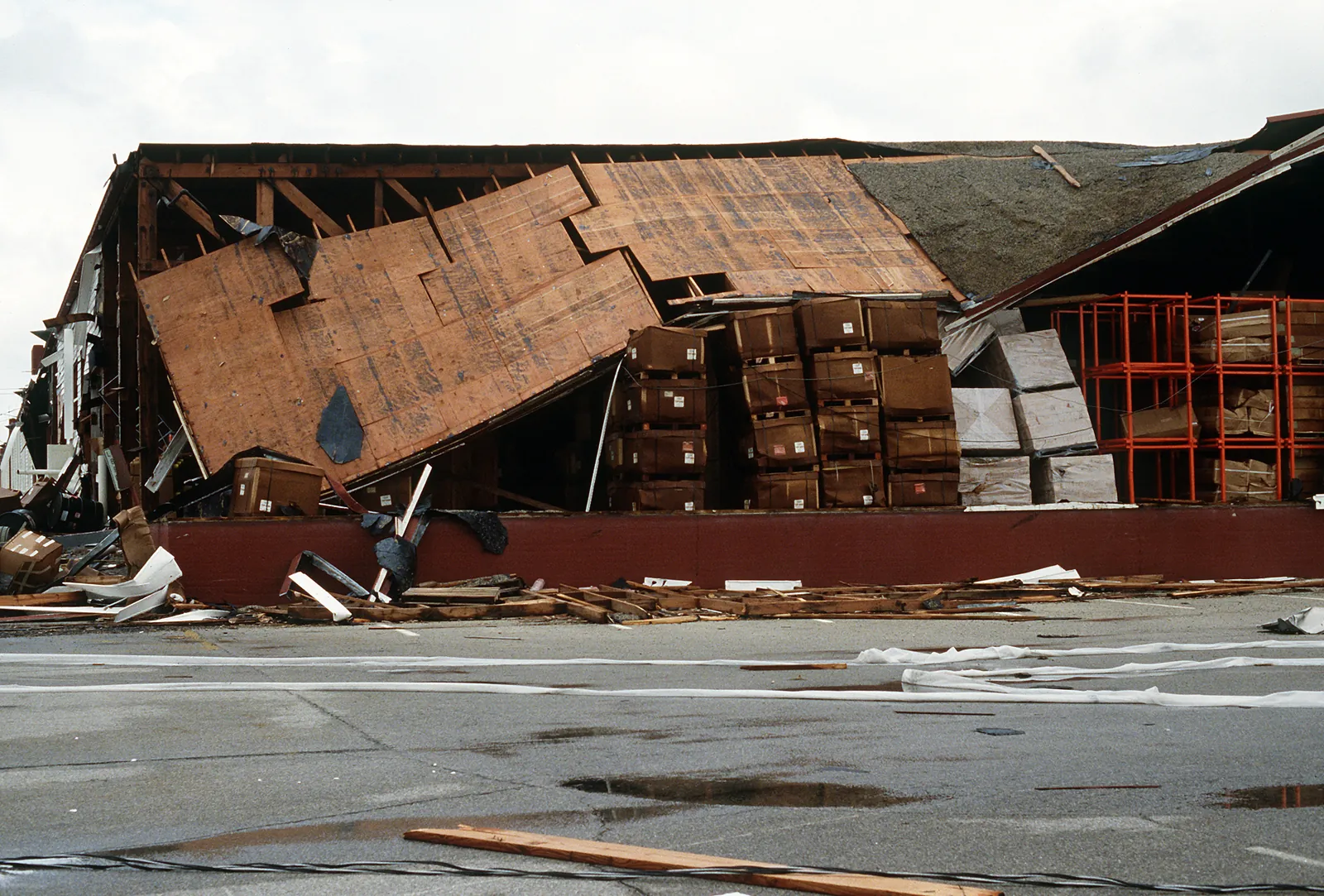
A warehouse whose roof deck has collapsed onto pallets of boxed stock and orange racking
  1. The roof deck, down: building
  2. Stock, still on its pallets: business personal property
  3. Racking and equipment: business personal property

A warehouse after Hurricane Gilbert, San Antonio, Texas, 1988. Building and contents in one frame, and business income in every day the doors stay shut. U.S. Air Force photograph, public domain.

The coverages a commercial property loss usually triggers
Coverage What it pays for Where it is disputed
Building CP 00 10 The structure, its systems and its permanently installed fixtures, at replacement cost or actual cash value as the declarations say. Scope, pricing, repair or replace, and what the code requires.
Business personal property CP 00 10 Furniture, equipment and stock, and a tenant’s improvements and betterments. The inventory, how stock is valued, and what could be saved.
Business income and extra expense CP 00 30 Net income and continuing expenses for the period of restoration, and the extra cost of staying open. How long the restoration should take, and what the business would have earned.
Ordinance or law CP 04 05 Code upgrades, demolition of undamaged parts, and the increased cost of construction, where the policy is endorsed for it. What the building department will require, and when.
Additional coverages CP 00 10 Debris removal, preservation of property, pollutant clean-up and electronic data, each with its own formula or limit. Whether the costs were captured, and under which line.

What appraisal can and cannot decide on a commercial claim

Before anything else, we sort the disagreement. If it is about value or amount, the appraisal clause can settle it. If it is about whether the policy covers the loss, it cannot, and we will say so.

What the appraisal panel decides

  • What the repair costs

    Building by building, by system and trade.

  • The scope of the work

    Repair or replace, matching, and what the assembly needs once opened.

  • The value of the property

    At the time of loss, stated separately on the award.

  • Actual cash value

    The depreciation taken, and whether it was reasonable.

  • Business income

    Net income and operating expense, under its own clause.

What a court decides

  • Whether the policy covers the loss

    Exclusions, endorsements and any denial.

  • How the policy is read

    Interpretation is law, not valuation.

  • Bad faith, interest and penalties

    And any fees that follow from them.

  • The deadline to sue

    Two years from the loss in the standard commercial conditions, unless state law says otherwise.

  • Anything the clause does not give the panel

    An award that decides it can be set aside.

Two questions that depend on your policy and your state

Coinsurance
The panel can set the value of the property. Whether a penalty then applies is the policy’s arithmetic, and a dispute about it is for a court.
Causation
Whether the panel may decide what caused the damage varies by state. The rule in your state

Not sure which side of the line your disagreement falls on? Send us the carrier’s letter and its estimate, and we will tell you, at no charge. Request a commercial claim review

What each part of the commercial appraisal clause means

The appraisal condition of the standard commercial property form, quoted in full. Each mark has its note; the flagged ones are where it parts from a homeowners policy.

Building and Personal Property Coverage Form E. Loss Conditions

2. Appraisal. If we and you disagree on the value of the property or the amount of loss, either may make written demand for an appraisal of the loss. In this event, each party will select a competent and impartial appraiser. The two appraisers will select an umpire. If they cannot agree, either may request that selection be made by a judge of a court having jurisdiction. The appraisers will state separately the value of the property and amount of loss. If they fail to agree, they will submit their differences to the umpire. A decision agreed to by any two will be binding. Each party will:

a. Pay its chosen appraiser; and

b. Bear the other expenses of the appraisal and umpire equally.

If there is an appraisal, we will still retain our right to deny the claim.

CP 00 10 10 12 Page 10 of 16
  1. Appraisal can settle the property’s value Differs from a homeowners policy

    A homeowners clause reaches only the amount of loss. The commercial clause adds the value of the property, the figure the coinsurance condition is measured against.

  2. Either side can demand appraisal in writing

    The carrier can demand appraisal as well as you. If it demands first, you still choose your own appraiser.

  3. Your appraiser must be competent and impartial

    On a commercial loss, competent means able to price a building by system and trade. Impartial means no stake in the number, which is why we are never paid a percentage of it.

  4. There is no set deadline to name appraisers Differs from a homeowners policy

    A homeowners policy allows 20 days to name an appraiser and 15 to agree on an umpire. The commercial form sets no period, though some states add one. The time to sue keeps running, so a demand should not wait.

  5. The award lists value and loss separately Differs from a homeowners policy

    The award carries the value of the property and the amount of loss as separate figures, so coinsurance and payment both work from the same signed page.

  6. Two signatures make the award binding

    Most items settle between the two appraisers; the umpire decides only what they cannot. An award signed by any two binds both sides on the amount.

  7. Each side pays its own appraiser

    The carrier pays its appraiser and you pay yours. The umpire and the other expenses of the appraisal are shared equally.

  8. The insurer can still deny coverage Differs from a homeowners policy

    The panel settles figures, not coverage. The commercial form says so in its own words; a homeowners clause does not.

The business income form, CP 00 30, carries the same clause for disagreements about “the amount of Net Income and operating expense or the amount of loss.”

How the coinsurance penalty works on a commercial claim

Most commercial policies carry a coinsurance condition, commonly at 80, 90 or 100 percent. If the limit you carried is less than that share of the building’s value at the time of loss, the policy pays only a proportion of the loss, and the business carries the rest.

The value is measured on the policy’s own basis: replacement cost where that coverage applies, actual cash value where it does not. A carrier’s valuation is an estimate like any other, and the commercial clause lets either side put the value to the panel. Move it, and watch what the same loss pays.

If the declarations show an agreed value for the building, the coinsurance condition does not apply to it until that agreed value expires. It is among the first things we look for.

Has the carrier applied a coinsurance penalty? The valuation behind it can often be appraised. Send us the declarations and the calculation

Value of the building at the time of loss

$4,000,000
Limit of insurance
$3,000,000
Coinsurance
90%
Amount of loss
$640,000
Deductible
$25,000
  1. 1 Value × 90%, the insurance required $3,600,000
  2. 2 Limit ÷ step 1 0.833
  3. 3 Loss × step 2 $533,333
  4. 4 Less the deductible −$25,000

The policy pays

$508,333

Lost to the penalty

$106,667

The four steps are the policy’s own (CP 00 10, Additional Condition F.1). The figures are an illustration, not a record of any claim.

Why commercial roof claims are often underpaid

A house is estimated room by room. A commercial building is priced by system and by trade, and the costliest disagreements are rarely about unit prices. They are about whole layers of the building that never made it into the scope.

A low-slope roof is the clearest case. What shows from above is the membrane. What the building depends on is everything under it, and water that gets through the first layer soaks the rest.

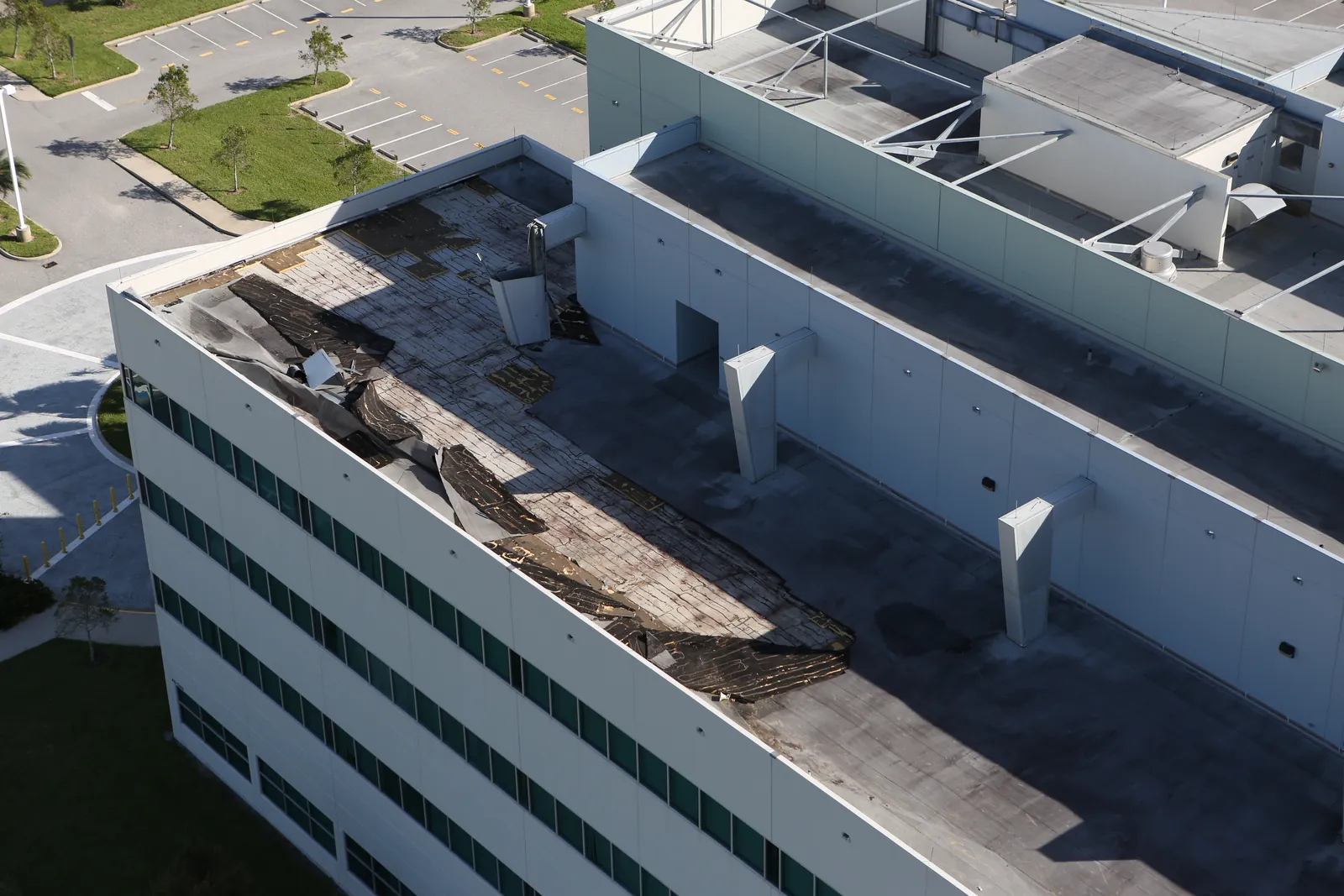
The flat roof of an office building with its membrane torn and rolled back, exposing the boards beneath
  1. Membrane torn and rolled back
  2. Boards beneath exposed, fastener plates showing
  3. Curbs and ductwork through the roof
  4. Parapet and edge metal

An office building after Hurricane Matthew, Florida, 2016. NASA photograph, public domain.

What the carrier’s estimate left out of this roof

Seven layers and parts, each a line of its own. The carrier’s estimate in this example patched the membrane and stopped there. Point at a layer to find it in the drawing.

A low-slope roof cut back in steps to show its layers, from the steel deck to the membrane, with edge metal and a rooftop unit on its curb. 1 2 3 4 5 6 7
  1. Rooftop unit and curb To the umpire CarrierComb the coil fins AppraisedReplace two units, new curb adapters
  2. Edge metal and coping Agreed CarrierRepair 80 lf AppraisedReplace 1,310 lf
  3. Membrane, TPO 60 mil To the umpire CarrierPatch 1,200 sf AppraisedReplace 41,200 sf
  4. Cover board To the umpire CarrierNot included AppraisedReplace 41,200 sf
  5. Insulation, tapered polyiso Agreed CarrierNot included AppraisedReplace 9,800 sf found wet
  6. Vapor retarder Agreed CarrierNot included AppraisedReplace at the wet areas
  7. Steel deck Agreed CarrierNo damage AppraisedNo damage, confirmed by core cuts

Outlined in brass: the 3 layers the carrier’s estimate left out. Thicknesses are exaggerated; the figures are an illustration, not a record of any claim.

How a commercial estimate is priced by trade

Commercial estimates are organized like construction documents, by the divisions of the work. Read that way, two estimates show at a glance where they part. This is the summary page of the same loss.

Estimate summary, Building 1

An estimate summary by construction division, comparing the carrier’s figures with the appraised figures
Division Work The carrier’s estimate The appraised estimate
01 General requirements Supervision, temporary protection, the crane, daily clean-up $4,200 $61,400
02 Existing conditions Tear-off of the roof assembly, haul and disposal $12,600 $37,900
07 Thermal and moisture protection Insulation, cover board, membrane, flashing, edge metal $88,400 $311,330
08 Openings Storefront glazing and framing, three bays $16,200 $27,800
09 Finishes Ceilings, drywall and flooring below the roof leaks $19,800 $34,600
23 Heating, ventilating and air conditioning Two rooftop units, curb adapters, start-up $2,100 $54,200
26 Electrical Disconnects and controls at the rooftop units $0 $6,100
Subtotal $143,300 $533,330
General contractor’s overhead and profit $0 $106,670
Replacement cost, Building 1 $143,300 $640,000

Divisions follow the numbering contractors use for commercial work. The figures are an illustration, not a record of any claim; the total is the Building 1 figure used in the valuation above and carried to the award below.

General conditions
Supervision, temporary protection, site safety and clean-up on a job measured in weeks.
Equipment
The cranes, lifts and scaffolding the work cannot be done without.
Phasing
Work sequenced so the business can keep trading, and the after-hours premiums it brings.
Permits and engineering
The plans, letters and inspections the building department asks for before it signs off.

Where estimates fall short for each type of commercial building

A shopping center loses scope at its storefronts, a warehouse under its membrane, an association at the line between the master policy and the owners. Choose a building to see where we look first.

1 2 3

Retail and shopping centers

One roof over many businesses, and the claim has to keep them apart.

Where a carrier’s estimate tends to go short

  1. Storefront glazing and framing, the canopy, and the sign structures on it
  2. Roof membrane and rooftop units that serve several tenants at once
  3. Which finishes are the landlord’s building and which are a tenant’s improvements

On the policy. The standard form values a tenant’s improvements and betterments differently depending on whether they are repaired promptly, and pays nothing for them if someone else pays for the repair.

1 2 3

Warehouses and industrial

A large low-slope roof hides water a long way from where it came in.

Where a carrier’s estimate tends to go short

  1. Wet insulation under the membrane, found by moisture survey and core cuts rather than by eye
  2. The roof as an assembly, from deck to membrane, and the code that applies once it is replaced
  3. Dock doors, racking, and the stock and equipment inside

On the policy. Stock and equipment are business personal property, usually under a limit of their own. Stock you have sold but not delivered is valued at its selling price, less discounts and expenses.

1 2 3

Office and medical

Interiors are built in layers, and water moves through every one of them.

Where a carrier’s estimate tends to go short

  1. Ceiling grid and tile, drywall, flooring and millwork across whole suites, not single rooms
  2. Mechanical, electrical and plumbing systems, and the controls that run them
  3. Work phased floor by floor so tenants can stay, and the after-hours premiums it brings

On the policy. Electronic data has a separate and small limit under the standard form: $2,500 a policy year, unless the declarations show more.

1 2 3

Apartments and multifamily

The loss is counted unit by unit, and so is the rent.

Where a carrier’s estimate tends to go short

  1. Scope taken unit by unit, with the corridors and common areas between them
  2. Matching across buildings built to one design
  3. Balconies, breezeways and roofs that a sample inspection never reached

On the policy. For a landlord, lost rent is business income, written as rental value, and it runs for the same period of restoration as the repair.

1 2 3

Condominium and homeowners associations

The master policy, the declaration and every owner’s policy meet at the same walls.

Where a carrier’s estimate tends to go short

  1. Where the association’s responsibility ends and each owner’s begins, under the declaration
  2. Every building stated on its own line, so deductibles and limits can be applied to each
  3. Roofs and exteriors replaced to one standard across the community

On the policy. Wind and hail deductibles on association policies are often a percentage of each building’s value, which makes building-by-building figures essential.

1 2 3

Hotels and restaurants

The building is the business, and it earns by the night or by the cover.

Where a carrier’s estimate tends to go short

  1. Rooms of furniture, fixtures and equipment, down to the commercial kitchen
  2. Entrances and finishes that must match a brand standard
  3. Income that rises and falls with the season

On the policy. Business income is measured on what the business would likely have earned had there been no loss, so the season the loss fell in matters.

1 2 3

Houses of worship and schools

Older buildings, specialist finishes, and a building code that applies the moment work begins.

Where a carrier’s estimate tends to go short

  1. Stained and leaded glass, millwork, and the craft it takes to match them
  2. Large roof areas over sanctuaries, halls and gymnasiums
  3. Accessibility, fire and life-safety upgrades that a large repair triggers

On the policy. Code upgrades depend on ordinance or law coverage. The standard form carries a small allowance for the increased cost of construction; the ordinance or law endorsement provides more, to its own limits.

How a business income claim is appraised

“If we and you disagree on the amount of Net Income and operating expense or the amount of loss, either may make written demand for an appraisal of the loss.”

Business Income (and Extra Expense) Coverage Form, CP 00 30

The business income form pays the net income the business would have earned, and its continuing expenses, payroll included, for the period of restoration. That period begins 72 hours after the loss and ends when the property should be repaired with reasonable speed and similar quality. Extended business income then covers up to 60 more days while trade recovers, and extra expense applies from the start.

So the building and the income belong in the same appraisal. Leave the rooftop units out of the estimate and the period of restoration shrinks with it, before anyone has opened the books.

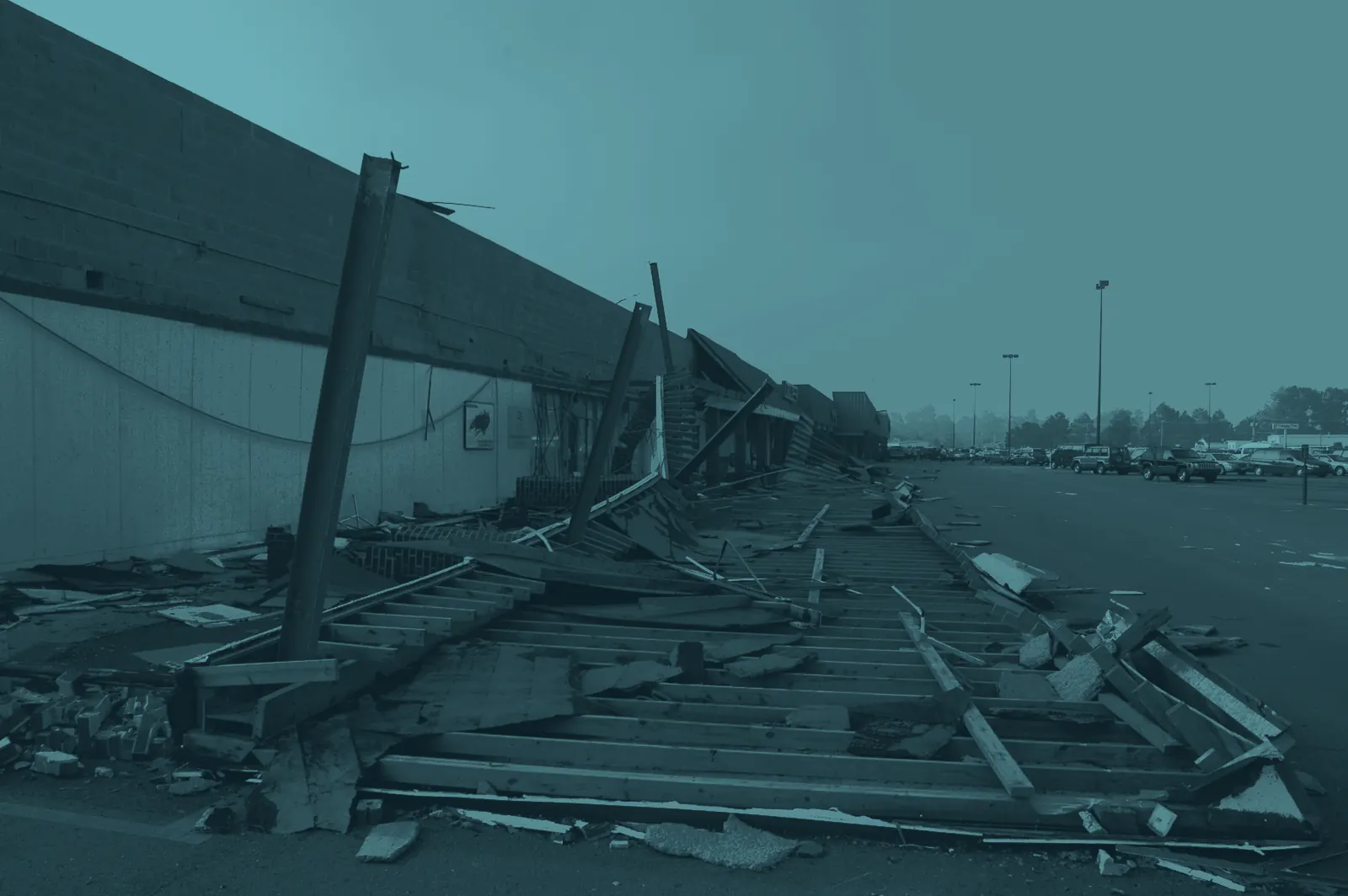
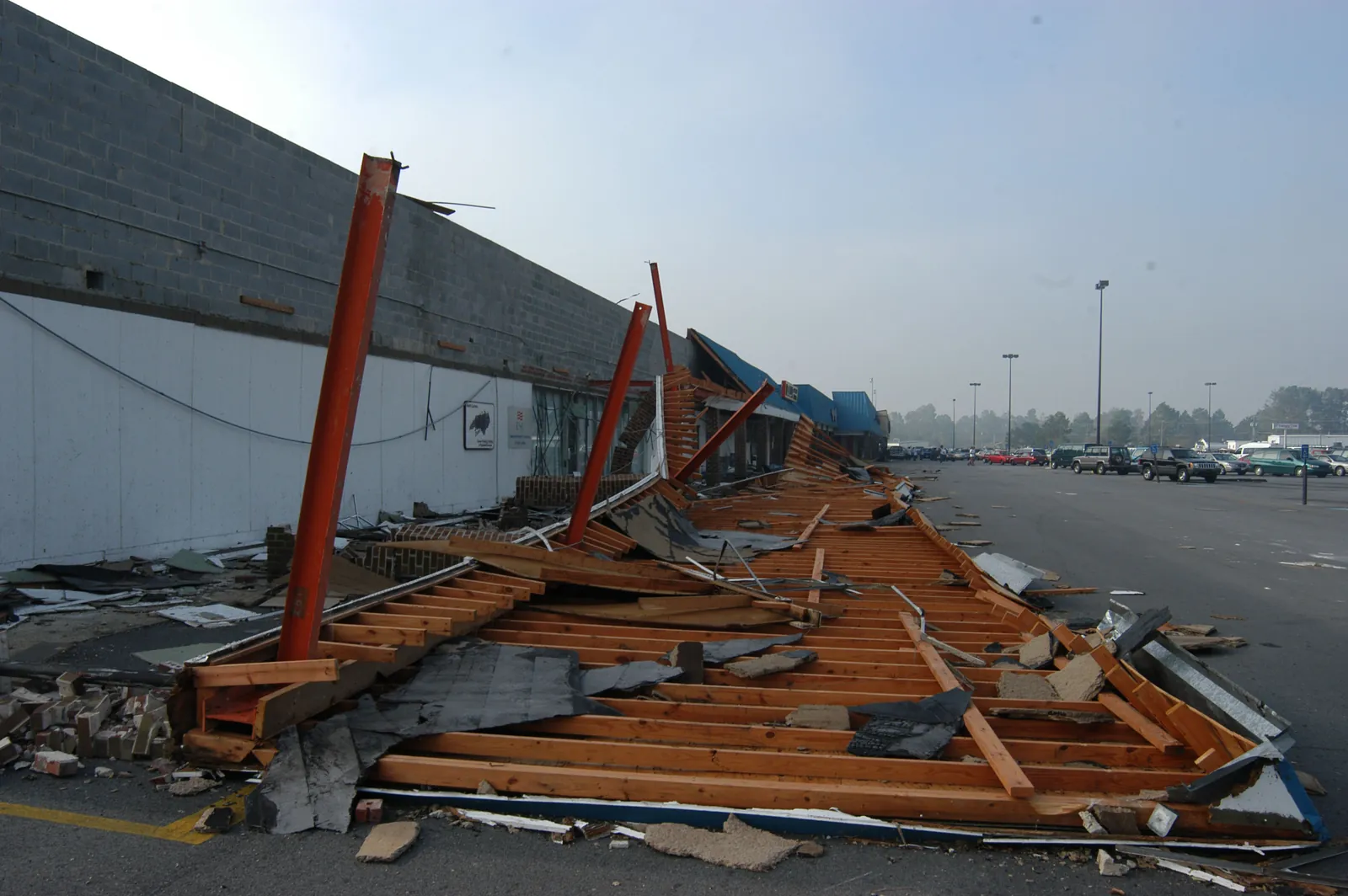
A shopping center’s walkway canopy torn down along a row of storefronts after a hurricane
  1. The walkway canopy, down along the shops
  2. Steel columns pulled from their footings
  3. Storefronts behind it, closed until it is cleared

A shopping center after Hurricane Isabel, Edenton, North Carolina, 2003. FEMA photograph by Mark Wolfe, public domain.

How business income loss is calculated

  • The net income of the business before the loss
  • What it would likely have earned had the loss not happened, season included
  • The operating expenses, payroll among them, needed to resume trading
  • The financial records, bills and invoices behind each of those

Under the standard form, extra time needed to meet a building code is not part of the period unless an endorsement adds it. We read for that endorsement first.

How the repair schedule sets the period of restoration

  1. Emergency dry-in and mitigation
  2. Moisture survey and engineering
  3. Permit review
  4. Rooftop units on order, ten-week lead time
  5. Roof tear-off and replacement
  6. Storefront glazing
  7. Interior repairs below the leaks
  8. Rooftop units set, controls, start-up
  9. Inspections and reopening

Period of restoration

15 weeks

Business income for the period

$184,000

Periods from the standard business income form (CP 00 30). Business income here is about $12,300 a week of net income and continuing expenses. The schedule and figures are an illustration, not a record of any claim.

Is the business income figure in dispute? Bring the profit and loss statements, and we will read them against the schedule. Request a commercial claim review

How the commercial appraisal process works

Six phases, each ending in a document you can read. The commercial form sets no days for any of them; we will give you our expectation of timing at the review.

  1. Review

    We read the whole policy and the dispute, and tell you plainly whether it is one appraisal settles.

    A written answer, before you commit to anything

    From youThe complete policy, the carrier’s estimate and its letters

  2. Demand

    A written demand naming us as your appraiser, or our appointment if the carrier has demanded first.

    The demand letter, or our acceptance of the appointment

    From youYour authority to appoint us; for an association, the board’s decision

  3. Inspection

    Building by building, usually alongside the carrier’s appraiser, with moisture surveys and core cuts where the roof calls for them.

    Inspection notes, measurements and a photo log

    From youAccess to every building, roof and system in dispute

  4. Estimate

    Priced division by division in the carrier’s format, and business income built from the books for the period the repair sets.

    Our estimate and business income analysis

    From youBids, invoices and, for business income, the financial records

  5. Reconciliation

    Line by line with the carrier’s appraiser. What remains goes to the umpire, with written submissions and, on a large loss, an inspection.

    The reconciliation, and an umpire submission if one is needed

    From youYour decision on any offer to settle part of the claim

  6. Award

    An award signed by any two, every figure stated separately. Payment follows within 30 days of the award and a sworn proof of loss.

    The signed award, itemized

    From youA sworn proof of loss if asked for, and invoices as the repair proceeds

Replacement cost is paid as the work is done. If you take actual cash value first, the form requires notice within 180 days of the loss that you intend to claim the rest. We give you both dates the day the award is signed.

What a commercial appraisal award looks like

The award for the loss on this page. Building 1 is the estimate total, its value is the one the panel set, and business income is the fifteen weeks the schedule found.

Appraisal award

Value and amount of loss

Named insured
Policy number
Date of loss
Locations

We, the undersigned, having been appointed under the appraisal conditions of the policy, have examined the damaged property and determined the value of the property and the amount of loss, stated separately below. This award is made without determination of coverage.

Amount of loss by item, at replacement cost and actual cash value
Amount of loss Replacement cost Actual cash value
Building 1, retail and office $640,000 $486,200
Building 2, warehouse $212,400 $171,900
Business personal property, Building 1 $96,800 $74,100
Ordinance or law, increased cost of construction $58,300 On completion
Value of Building 1 at the time of loss
$3,300,000
Business income, a fifteen-week period of restoration
$184,000

Appraiser for the insured

Appraiser for the insurer

Umpire, not required

Illustrative figures, not a record of any claim.

  1. Each building is listed separately

    Limits apply building by building, and percentage deductibles are figured on each building’s value, so the award keeps them apart.

  2. Replacement cost and actual cash value for every item

    Actual cash value is paid now. The rest of the replacement cost follows when the repair is done, as soon as reasonably possible.

  3. The building’s value is stated separately

    The figure coinsurance is measured against, so the condition is applied to a number both sides signed.

  4. Business income is listed separately

    Appraised under the business income form’s own clause, for the period of restoration the repair sets.

  5. The award does not decide coverage

    The award settles amounts. Whether each is covered remains a separate question, as the commercial form provides.

  6. Two signatures make the award binding

    An award signed by any two of the three binds both sides on the amount. The umpire signs only if needed.

Under the standard form, the carrier pays within 30 days after it has the sworn proof of loss and the award.

Who will handle your commercial claim

A commercial award is read by more people than most: owners, boards, lenders, and sometimes a court. The file behind it is prepared for every one of them.

Danielle Selph

Reads and interprets the policy

Danielle Selph

Licensed since 2018

Danielle has managed and interpreted residential and commercial claims in every mainland state and in Canada. She reads a commercial policy as the contract it is, forms, endorsements and schedules together, sorts value from coverage before anything is spent, and notices when a carrier leans on an internal guideline instead of the policy.

Joshua Selph

Inspects and documents the building

Joshua Selph

Adjusting since 2004

Joshua spent two decades as a field and desk adjuster and led the specialty documentation teams carriers bring in when a file has to withstand scrutiny. Every appraisal file is prepared to that standard: measured, photographed and recorded so the other side can check it and find it holds.

We work alongside your broker, public adjuster, attorney or accountant, and stay inside the appraiser’s role. More about Joshua and Danielle

What a commercial appraisal costs

A commercial or association appraisal is a flat $10,000, stated in writing before anything starts. It is for our professional time, and it is due regardless of the outcome.

It is never a percentage of the award. The policy requires your appraiser to be impartial, and an appraiser paid a share of the number is not. The same clause settles the rest: the carrier pays its own appraiser, and the umpire is shared equally.

Residential appraisals are a flat $2,500. How we work

Common questions about commercial appraisal

Documents to have ready

The policy
The loss
Business income
Where the claim stands

Check off what you already have. A review can start with the declarations and the carrier’s estimate; we will ask for the rest as we need it.

Or call (945) 248-2554. One of us answers.

Can a commercial property claim go to appraisal?

Yes, when the disagreement is about value or amount.

The standard commercial property form (ISO CP 00 10) and the business income form (CP 00 30) each carry an appraisal condition, and most carriers’ own commercial forms follow them. If the carrier has accepted the loss but you disagree on what it costs to repair, what the property was worth, or how much income was lost, either side can demand appraisal in writing.

Is a commercial appraisal different from a residential one?

The structure is the same: two appraisers, an umpire if they cannot agree, and an award that binds when any two sign it.

The commercial clause adds three things. The panel can be asked to set the value of the property as well as the loss, the form itself sets no days for naming appraisers, and it says outright that the carrier keeps its right to deny the claim. In practice the files are larger, the estimates are priced by trade, and an umpire on a large loss may inspect the property and take written submissions from both sides.

Can business income be appraised?

Yes. The business income form has its own appraisal condition, for disagreements about “the amount of Net Income and operating expense or the amount of loss”. The figure turns on two things: what the business would likely have earned, which comes from its records, and how long the period of restoration should run, which comes from the repair. A building scope that leaves work out also shortens the business income claim, so the two are best appraised together.

Our policy has a coinsurance clause. Can appraisal help?

It can settle the figure the clause depends on.

Coinsurance compares the limit you carried with the value of the property at the time of loss, and the commercial appraisal condition lets either side put that value to the panel, which states it separately from the amount of loss. Whether a penalty then applies follows from the policy’s own arithmetic. If the property was insured on an agreed value basis, the coinsurance condition does not apply to it until that agreed value expires.

Does the panel decide whether the policy covers the loss?

No. The commercial form says it in so many words: “If there is an appraisal, we will still retain our right to deny the claim.” The panel sets values and amounts. Whether the policy covers the loss, how an exclusion or endorsement applies, and whether the carrier acted in bad faith are questions for a court. We will tell you which kind of disagreement you have before you spend anything with us.

How long does a commercial appraisal take?

It depends on the size of the loss and how much is in dispute.

A single-building roof claim can conclude in a few months; a multi-building loss with business income can take longer, particularly if the umpire is needed. It is still usually faster than litigation. Watch the suit deadline while it runs: the standard commercial conditions allow two years from the date of loss, states can change that, and in most states appraisal does not pause it.

Can our public adjuster or contractor serve as our appraiser?

Be careful.

The commercial clause requires each side to select a competent and impartial appraiser, and courts have set aside awards where the policyholder’s appraiser was paid a percentage of the claim or held an assignment of it. A public adjuster paid on a percentage, or the contractor who will perform the repair, has a stake in the number. They can still help with the claim; the appraiser should be someone without that stake.

We are a condominium or homeowners association. Can the association demand appraisal?

Usually, yes.

The association is the named insured on the master policy, so the demand is made in its name, normally on a decision of the board under its governing documents. The declaration decides where the association’s responsibility ends and each owner’s begins, and the owners’ own policies have appraisal conditions of their own. Percentage wind and hail deductibles are common on association policies, so the award should state each building separately.

What does a commercial appraisal cost?

A commercial or association appraisal is a flat $10,000.

$2,000 retains us and opens the file, and the remaining $8,000 is due when the award is signed. The fee is for our professional time and is due regardless of the outcome; it is never a percentage of the award. As the policy provides, the carrier pays its own appraiser and the umpire’s fee is split equally.

Request a free commercial claim review

Send us the policy and the carrier’s estimate. We will read both, tell you plainly whether appraisal fits the disagreement, and quote the work in writing. There is no charge for the review.

  1. We read the policy, the carrier’s estimate and its letters.
  2. We tell you whether the disagreement is one appraisal settles, and if it is not, who can help.
  3. If it fits, you have our quote in writing before anything starts.
The same commercial building, repaired, with its windows lit. 60′-0″